Positional Sparring vs Live Rolling Explained

A five-minute round can be a lot of things. It can be a hard, competitive exchange that tests whether you can impose your game on a resisting partner. It can also be five minutes spent repeatedly getting stuck under side control without learning how to leave. The difference often comes down to positional sparring vs open rolling and knowing what you need from that day’s training.
Neither format is better across the board. Positional rounds give you concentrated repetitions in a specific problem. Open rolling teaches you how to connect skills, manage uncertainty, and make decisions when neither person agrees to start where you want. A healthy Jiu Jitsu routine needs both.
What positional sparring actually does
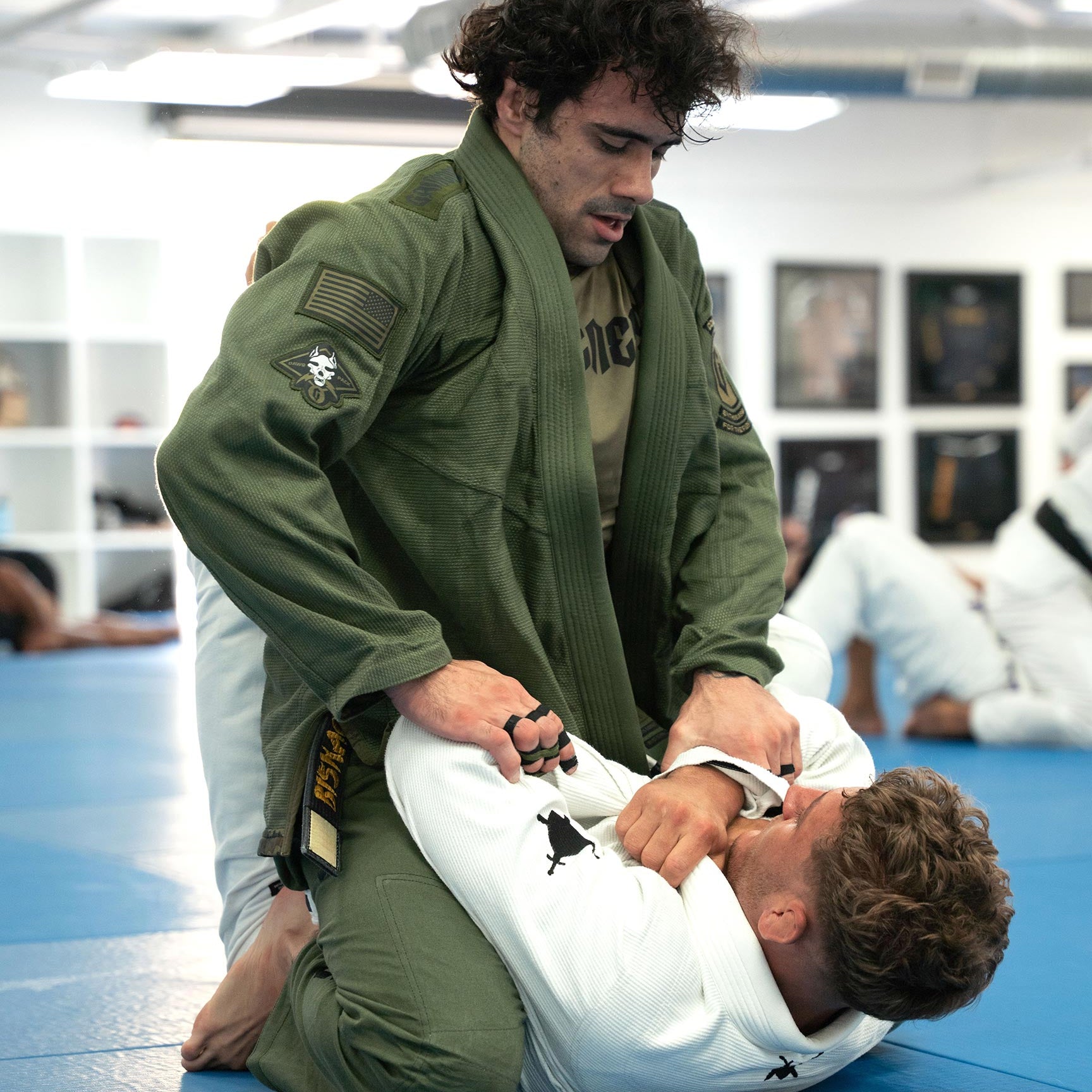
Positional sparring starts with both students in a defined situation and gives each person a clear job. You might begin with one partner mounted and the other working to escape, start from seated guard with one player trying to pass, or reset every time someone reaches the back.
The constraint is the point. Instead of spending most of a round hand-fighting from standing or circling through familiar positions, you repeatedly work on the area that needs attention. If your elbow-knee escape is late, positional sparring gives you enough attempts to recognize the early warning signs: the crossface settling in, your near-side elbow drifting away from your ribs, or the opponent climbing to high mount.
That repetition also changes how you measure success. A white belt escaping side control once during an open round may not know whether the escape was sound or whether their partner simply moved on. In a side-control escape round, they can test the same frames, hip movement, and underhook battle against progressively better resistance. The details become easier to feel.
Positional rounds are especially useful after a technique lesson. Say the class practiced a knee-cut pass from headquarters. Rather than immediately going into full sparring, start one partner in headquarters with the knee shield in place. The passer works to clear the frame and establish control; the guard player works to recover guard, come up on a single leg, or create enough distance to reset. Now the technique gets tested before it disappears into the chaos of an open round.
Positional sparring vs open rolling: the real difference
The simplest distinction is scope. Positional sparring narrows the game so you can develop a skill. Open rolling expands it so you can apply skills under changing conditions.
Open rolling has transitions that no planned drill can fully copy. You may defend a takedown, land in a front headlock, lose the front headlock during a scramble, and finish the exchange fighting from half guard. Those moments teach timing, pacing, grip choices, and awareness of risk. They also reveal whether you can find your preferred positions without being handed them.
That makes open rolling essential for competitors, but it is not only for competitors. A hobbyist who wants to feel less lost during class needs it too. Brazilian Jiu Jitsu is not a sequence of isolated positions. You need experience deciding when to attack, when to consolidate, and when an attempted pass is becoming a sweep opportunity for your partner.
Still, more open rounds do not automatically mean faster improvement. If you have trained for six months and every tough round ends with you flattened in half guard, another week of trying to "just roll more" may reinforce the same defensive habits. Starting from bottom half guard, with the top player already controlling the crossface, makes the problem unavoidable. That can be humbling, but it is usually productive.
When to choose positional rounds
Choose positional sparring when you can name the situation you want to improve. The target does not need to be an advanced submission chain. It can be as basic as surviving mount without extending your arms, retaining open guard after your feet are pushed aside, or finishing a single-leg entry after you reach the leg.
It is also a smart choice when the skill is new. Early on, most students need a cooperative drilling phase to understand the movement, then a progressive resistance phase to make it functional. Going from a few clean reps directly into a hard open roll is often too large a jump. The technique may never appear because both partners default to their established games.
Positional work is valuable when training partners are mismatched in size or experience as well. A larger, experienced student can give a newer student real but controlled resistance from closed guard or mount. The new student gets to practice a specific response instead of spending an entire round defending pressure they do not yet know how to manage. The advanced student still benefits by sharpening control, pressure, and the ability to solve escapes without relying on athleticism.
A good positional round has rules that are simple enough to remember while tired. For example, from back control, the attacker wins by submitting or holding control for a set count; the defender wins by getting their shoulders safely to the mat or reaching top position. Once someone wins, reset immediately. Avoid rule sets so complicated that both people spend more time debating points than grappling.
When open rolling is the better teacher
Choose open rolling when you need to test your overall game. It answers questions positional work cannot: Can you reach half guard from a standing start? Do you have a reliable response when your first sweep fails? Are you using too much energy chasing a submission that is no longer there?
It is also where you learn to chain positions. A guard pass rarely looks as clean in a live round as it did during drilling. Your knee-cut may turn into a body-lock passing situation, or your opponent may expose their back while recovering guard. Open rolling teaches you to recognize that the original plan has changed and continue grappling instead of mentally resetting.
For tournament preparation, open rounds should gradually become more specific to the demands of the event. A competitor may use rounds with a fresh partner rotating in, begin from the standing position, or ask partners to push a pace that resembles the division they are entering. But even during a competition camp, relying only on open rolling can leave obvious technical holes untouched. If opponents repeatedly recover guard from your passing sequence, devote part of the week to that exact exchange.
Open rolling also has a social value in academy culture. It is where you learn different body types, styles, tempos, and personalities. One partner plays a patient pressure game; another sits to guard and attacks legs; another scrambles relentlessly from turtle. Learning to work respectfully with all of them is part of becoming a well-rounded training partner.
Build a week that uses both
You do not need an elaborate schedule to balance the two. Let the class structure and your current needs guide you. After a class focused on a specific position, use one or two rounds to start there. During open rolling afterward, give yourself a modest process goal related to the lesson, such as getting to headquarters before passing or keeping inside elbow position while escaping mount.
If you attend only two classes a week, positional sparring can be even more valuable because repetitions are limited. Spend a few focused rounds on the position that keeps showing up in your rolls. If you train four or five times a week, alternate emphasis. One session might include several hard open rounds; another might be mostly technical work and controlled positional rounds.
Intensity matters more than many students realize. Positional sparring is not automatically light, and open rolling is not automatically a gym war. A mount-escape round can become exhausting quickly when both partners treat every reset like the final seconds of a match. Communicate before the round. Decide whether the goal is technical experimentation, realistic resistance, or hard conditioning. That makes the round safer and more useful.
Common mistakes that slow progress
The most common mistake in positional sparring is treating it like a submission hunt with a convenient starting point. If the round begins in side control and the top player instantly abandons position to chase a low-percentage armbar, both people lose the intended practice. Hold the position long enough to learn the control and escape battles inside it.
The opposite problem happens in open rolling when students refuse to attempt the techniques they are developing. They play only their safest game, avoid the new guard pass, and leave class saying the move does not work. Open rounds are messy, but they are still a place to take informed risks. Try the technique with good posture and grips, then notice precisely where it breaks down.
Another mistake is choosing positions based only on what feels fun. It is fine to spend time on your favorite attacks. But if you avoid bottom side control, late-stage guard retention, or standing exchanges because they are frustrating, those gaps tend to follow you into every round. Let recurring problems choose at least some of your positional work.
Let the round answer one question
Before the timer starts, ask a simple question: what am I trying to learn here? In a positional round, it may be whether you can recover an underhook before a half-guard passer settles chest-to-chest. In an open roll, it may be whether you can enter your preferred guard without forcing it.
That small amount of intention keeps training from becoming either repetitive drilling with no resistance or endless hard rounds with no direction. Use positional sparring to make a weak link less familiar. Use open rolling to see how that link holds up when the rest of Jiu Jitsu gets involved. Over time, the rounds that once felt like survival start giving you useful information.
Shop Our New Releases
Fast & Free Shipping!



Fast & Free Shipping!


Fast & Free Shipping!
Fast & Free Shipping!


Fast & Free Shipping!

Fast & Free Shipping!