How to Escape Side Control in BJJ
Getting stuck under side control is where a lot of rounds start to feel long. You frame, you bridge, nothing moves, and the top player settles in harder. If you want to learn how to escape side control BJJ without wasting energy, the answer is usually not one big explosive move. It is a sequence - survive the crossface, build frames, make space, get to your side, and connect that movement to a guard recovery or an underhook.
That matters whether you are a white belt getting flattened by heavier training partners or a competitor trying to avoid giving up points and pressure in the final minute. Side control escapes are less about memorizing ten separate techniques and more about understanding what has to happen first.
How to escape side control BJJ starts with survival
Most bad escapes fail before they start because the bottom player is already too flat. If your shoulders are pinned, your head is turned away, and your near-side elbow is floating, your partner is not just holding you down. They are disconnecting your hips from your upper body.
The first job is survival. That means protecting your neck from the crossface, keeping your elbows tight enough that they cannot isolate an arm, and avoiding panic bridges that expose mount. A newer student often tries to bench press their partner off them. That works almost never against someone with decent pressure.
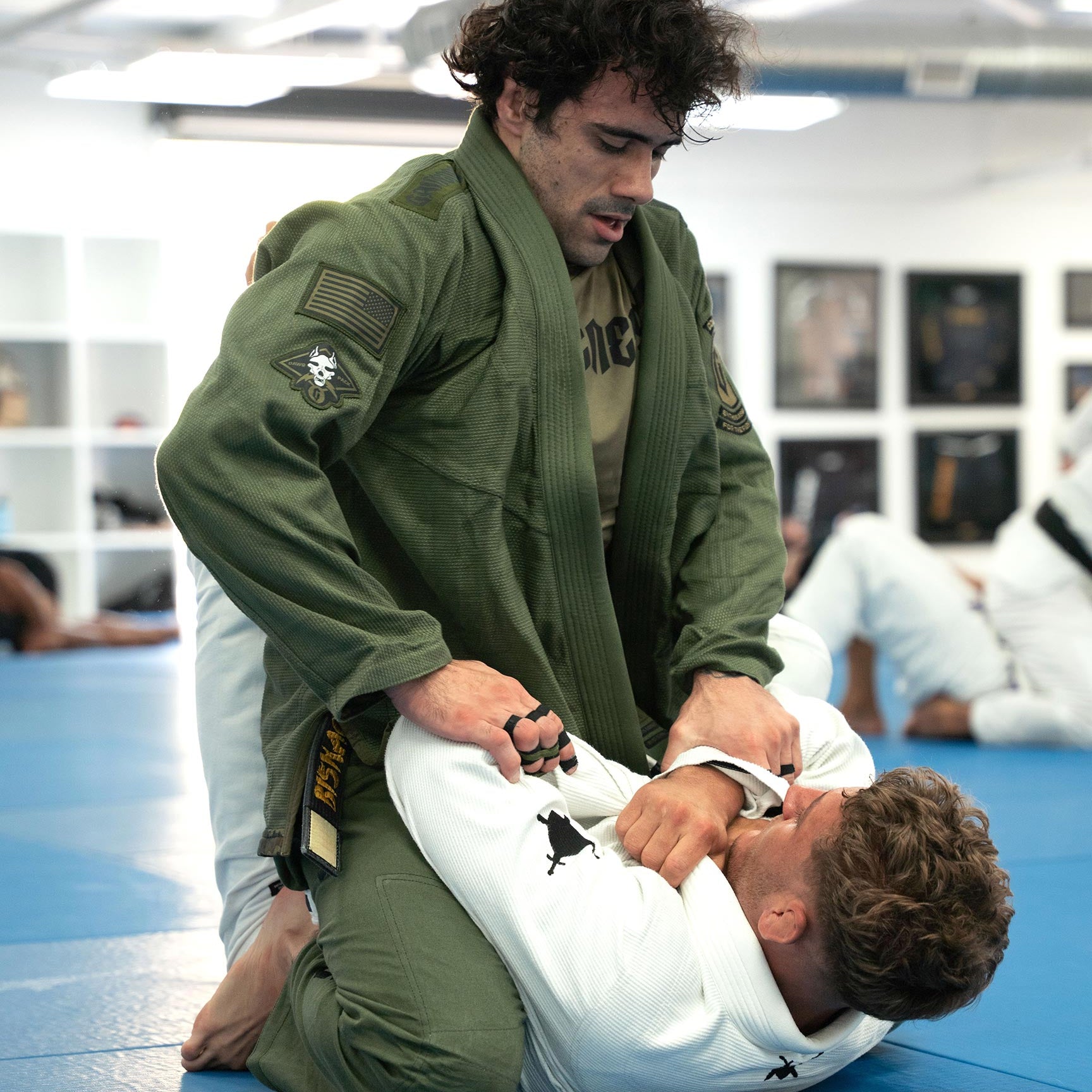
A better starting point is this - frame with your forearm across the opponent's neck or jawline, keep your other arm ready to monitor their hip, and turn slightly onto your side. Even a small angle helps. In live sparring, that small angle is often the difference between feeling buried and feeling like you have a path back to guard.
If you train in the gi, be aware that your partner may use collar grips or lapel control to keep your shoulders pinned. In no gi, the control may come more from head position and chest pressure. The principle is the same. You need to create a structure with your arms before your hips can move.
The two frames that matter most
When people ask how to escape side control BJJ, they usually want a move. What they really need are reliable frames.
The first is the neck frame. Your forearm goes across the opponent's collarbone, neck, or jawline. This is not a push-up. It is a wedge that stops them from collapsing all their weight into your head and shoulders. If your arm is too extended, they can swim around it or attack an arm triangle setup. If it is too loose, the crossface comes right back.
The second is the hip frame. Your other hand or forearm blocks the near hip so they cannot slide to mount as you move. This is one of the most common beginner mistakes. They focus only on the head and forget the hips, then the top player switches from side control to mount the second space appears.
In drilling, try pausing here for a second. Ask yourself if your frames are holding shape without max effort. Good frames feel skeletal, not muscular. You should be creating space with alignment, not trying to outlift someone who has gravity on their side.
The basic side control escape that works most often
For most students, the highest percentage answer is recovering guard, not trying to reverse the position right away.
Start by getting your neck and hip frames in place. Shrimp your hips away just enough to bring your bottom knee inside. The goal is not a giant movement across the mat. It is to insert your knee between you and your partner. Once that knee is in, you can begin recovering half guard, knee shield, or full guard depending on how much space you created.
This sounds simple, but timing matters. If you shrimp before your frames are set, your partner follows and crushes you flat again. If you frame but never move your hips, they settle and kill your arms. The sequence has to connect.
A common sparring example looks like this - your partner crossfaces hard, you address the neck first, then block the hip, shrimp once, bring your knee in, and catch half guard. From there, the round changes. You are no longer pinned under side control eating shoulder pressure. You are back in a guard where you can start attacking sweeps or reguarding fully.
For bigger opponents, half guard is often the realistic first win. Do not ignore that because you wanted full guard. Against someone with strong pressure, getting any guard back is a good escape.
When to bridge before you shrimp
Sometimes the space for the knee does not exist yet. That is where the bridge comes in.
Bridge to make your partner post or shift their weight, then immediately shrimp while that weight is light. The mistake is bridging straight up and stopping there. A bridge by itself rarely escapes side control against a trained partner. It is a setup for the hip movement that follows.
In competition rounds, you see this all the time. One athlete bumps, the top player adjusts, and that brief adjustment opens enough room for the bottom knee to slide in. It is a small window, but that is usually all you get against good top pressure.
The underhook escape is powerful, but it has trade-offs
If your opponent gives you space near the far side, the underhook escape becomes a strong option. Swim your arm underneath their torso, get onto your side, and start coming up to your knees or building into a single-leg style position.
This works especially well against side control players who are loose with their near-side hip control or who focus so much on the crossface that they leave space under their body. Many wrestlers and experienced scramblers prefer this route because it can turn defense directly into an offensive exchange.
But there is a trade-off. If you reach lazily for an underhook while flat on your back, you can gift your partner an arm isolation, a deeper crossface, or a transition to north-south. You need angle first. Get to your side, hide your elbow, then pummel for the underhook.
At many academies, white belts hear "get the underhook" and start chasing it from bad positions. That advice is not wrong, but it is incomplete. The underhook is great when your structure is already in place. Without frames and hip movement, it often turns into wishful reaching.
Common mistakes that keep people pinned
One of the biggest mistakes is carrying your elbows away from your ribs. Side control escapes live and die on elbow position. If your arms flare out, the top player controls your head and isolates your far arm. If your elbows stay tight, your frames are much harder to collapse.
Another mistake is trying the same tempo against everyone. A fast, athletic passer may require immediate framing and movement before they settle. A heavy, pressure-based player may force you to be more patient, using short bridges and incremental hip movement instead of one big escape attempt.
A third mistake is ignoring head position. If your face is turned away and your spine is twisted, your bridge gets weaker and your shrimp gets shorter. Even a small adjustment that lets you square your head and shoulders can improve your escape.
There is also the academy mistake everyone makes at some point - drilling the escape with a cooperative partner, then getting frustrated when it disappears in live rounds. Side control escapes need progressive resistance. Start with light top pressure, then increase it. If you only practice against someone letting you move, your timing will not carry over to sparring.
Drilling side control escapes so they show up in live rolls
The best way to build this skill is to isolate it. Start rounds from bottom side control with your partner trying to hold and advance while you focus only on reguarding or getting to an underhook. Short rounds work well here because the position is demanding.
A good example is three one-minute rounds starting under side control with fresh partners. In the first round, your only goal is to recover half guard. In the second, work on getting to your side and building frames before any escape attempt. In the third, mix guard recovery with underhook options based on what your partner gives you.
Another useful approach is to have your coach or training partner vary the top control. One round they use heavy crossface pressure. The next they stay more mobile and threaten mount. That forces you to recognize what kind of side control you are escaping instead of treating every hold the same.
If you are newer to Brazilian Jiu Jitsu, expect this position to feel frustrating for a while. That is normal. Escaping side control against experienced upper belts is one of the clearest reminders that technique and timing matter more than effort alone.
What works for white belts versus advanced players
For white belts, the smartest focus is simple guard recovery. Build two frames, bridge to create a reaction, shrimp, and get your knee inside. Repeat that until it starts showing up automatically in rolling.
For blue belts and above, the question becomes more situational. Are you escaping someone with chest-to-chest pressure, reverse side control, kesa gatame, or a loose passing side control that is about to transition? Your escape should match the control. Sometimes reguarding is best. Sometimes coming up on the underhook is cleaner. Sometimes the right answer is preventing full side control before it settles in.
That last point is worth remembering. Some of the best side control escapes happen early, during the pass itself. If you can frame while your partner is still switching from headquarters or knee cut pressure into side control, you may recover before the pin is fully established. Advanced grapplers do this constantly. They are not always escaping a finished position. They are interrupting it.
The next time you get stuck under side control, do less and do it in the right order. Win your frames, turn onto your side, connect your bridge to your shrimp, and take the guard recovery if it is there. On the mat, small wins stack up fast.
Shop Our New Releases
Fast & Free Shipping!

Fast & Free Shipping!
Fast & Free Shipping!
Fast & Free Shipping!

Fast & Free Shipping!

Fast & Free Shipping!