How to Pick Grappling Shorts That Stay Put
The wrong pair of shorts becomes obvious halfway through the first round. The waistband rolls while you are trying to pass headquarters, a loose leg catches on your partner’s knee during an armbar drill, or a stiff panel pulls when you squat into a combat base. Knowing how to pick grappling shorts means looking past the color and finding a pair that stays comfortable, moves with your hips, and holds up to regular Brazilian Jiu Jitsu training.
For most students, one good pair can cover open mat, no gi class, and hard rounds. But the best choice depends on how you train, your build, your academy’s culture, and whether you compete under a specific ruleset.
How to Pick Grappling Shorts for Your Training
Start with the job the shorts need to do. Grappling shorts are not just regular gym shorts with a tougher waistband. They are made to handle friction from mats, constant hip movement, pulling during scrambles, and repeated washing after sweaty classes.
If you train no gi two or three times per week, durability and a secure closure should be your first priorities. If you mostly train in a gi but want shorts for conditioning, drilling, or the occasional no gi class, a simpler and lighter pair may make more sense. Competitors should also consider tournament uniform requirements before buying a loud pattern or a particular colorway.
A useful real-world test is to think through the positions you hit every week. Can you comfortably pummel for underhooks? Can you sit to guard, shoot a double leg, and bring your knee to your chest for a triangle setup without the fabric binding? Shorts that feel fine standing in front of a mirror can feel completely different once you are retaining guard against a pressure passer.
Get the Fit Right First
Fit matters more than almost any feature. Grappling shorts should sit securely at your natural waist without needing to be cinched so tight that they dig in while you play seated guard. They should not slide down when someone snaps you down, sprawls on your hips, or grabs around your waist during a scramble.
A properly fitted pair usually feels close through the waist and relaxed through the hips and thighs. You need enough room to move, but not so much loose fabric that it bunches behind your knees or gives your training partner something to accidentally grab.
Waistband and closure systems
Most grappling shorts use an elastic waistband, a drawstring, a hook-and-loop closure, or a combination of these. Each can work well, but there are trade-offs.
An elastic waistband is quick, simple, and comfortable for everyday training. It is often a good choice for students who prefer fewer hard components around the waist. The drawback is that elastic can eventually lose some hold, especially if shorts are washed and dried aggressively.
A drawstring lets you fine-tune the fit. This is useful if you have a narrower waist relative to your hips or your weight fluctuates slightly during a competition camp. Look for a drawstring that stays flat and is positioned so it does not create an uncomfortable knot when you are folded over in closed guard.
Hook-and-loop closures can give the waistband a very locked-in feel, which some grapplers like for wrestling-heavy rounds. Make sure the closure lies flat and has a clean finish. Rough or exposed edges can catch on a rash guard, irritate your skin, or scratch a training partner during close contact.
The best setup is the one you forget about while rolling. If you have to adjust your shorts between every round, the fit or closure is wrong for you.
Length and leg opening
Most Brazilian Jiu Jitsu practitioners do well with shorts that land around mid-thigh to just above the knee. Shorter cuts can feel freer for high kicks or deep squats, but very short inseams may ride up when you are working from butterfly guard. Longer board-short styles offer more coverage, although too much length can bunch at the knee during leg pummeling or when you are trying to lock a triangle.
Pay attention to the leg opening as well. Lifters and grapplers with larger quads often need a slightly roomier cut. If the leg opening is too narrow, you will feel it immediately when drilling knee-cut passes or stepping over for a mounted armbar. If it is too wide, the material can flare and get in the way during scrambles.
Choose Fabric Built for Mat Friction
Most quality grappling shorts use polyester, spandex, or a blend of the two. Polyester handles sweat well, dries relatively quickly, and resists the abrasion that comes from daily mat work. Spandex adds stretch, which matters when you are bringing your knees high, sprawling, or fighting out of a tight body-lock pass.
More stretch is not always better. A highly stretchy, thin short can feel excellent on day one but may be less durable if you train hard several times a week. A heavier fabric with stretch panels may last longer, but it can feel warmer during packed summer classes. The right balance depends on your academy and how you train.
For a student who trains in an air-conditioned academy and mostly drills technical rounds, a lighter fabric may be ideal. For someone who attends crowded evening classes, does wall wrestling, and stays for open mat, a sturdier material and reinforced construction are usually worth the small increase in weight.
Look for stretch where it counts
A gusseted crotch or flexible inner panel is one of the most useful design details in grappling shorts. It gives the shorts room to move when you widen your base, invert under a leg drag, or step over your opponent’s torso from side control.
Side slits can also improve mobility, especially for people who find that standard athletic shorts bind at the hips. They are not mandatory, but they are helpful if you play a movement-heavy game with lots of guard retention, wrestle-ups, and quick angle changes.
Try a few motions before removing the tags: squat low, raise one knee toward your chest, take a wide lateral step, and sit on the floor with your knees bent. Those basic movements reveal more than simply checking the waist size.
Inspect the Details That Affect Durability
Grappling shorts live a rougher life than casual athletic shorts. They rub against mats, get stretched during takedown entries, and go through frequent wash cycles. Small construction details make a difference over months of training.
Look for reinforced stitching around the crotch, waistband, and side seams. Flat seams are often more comfortable because they reduce rubbing when you are pressure passing or spending several minutes pinned under mount. Strong bar tacks at high-stress points can also help prevent seams from pulling apart during hard rounds.
Avoid shorts with large external pockets, dangling cords, metal zippers, or hard plastic pieces. They can be uncomfortable, create a snag point, and may not be allowed at your academy. A small internal pocket can be fine for travel, but it does not add much value for actual training.
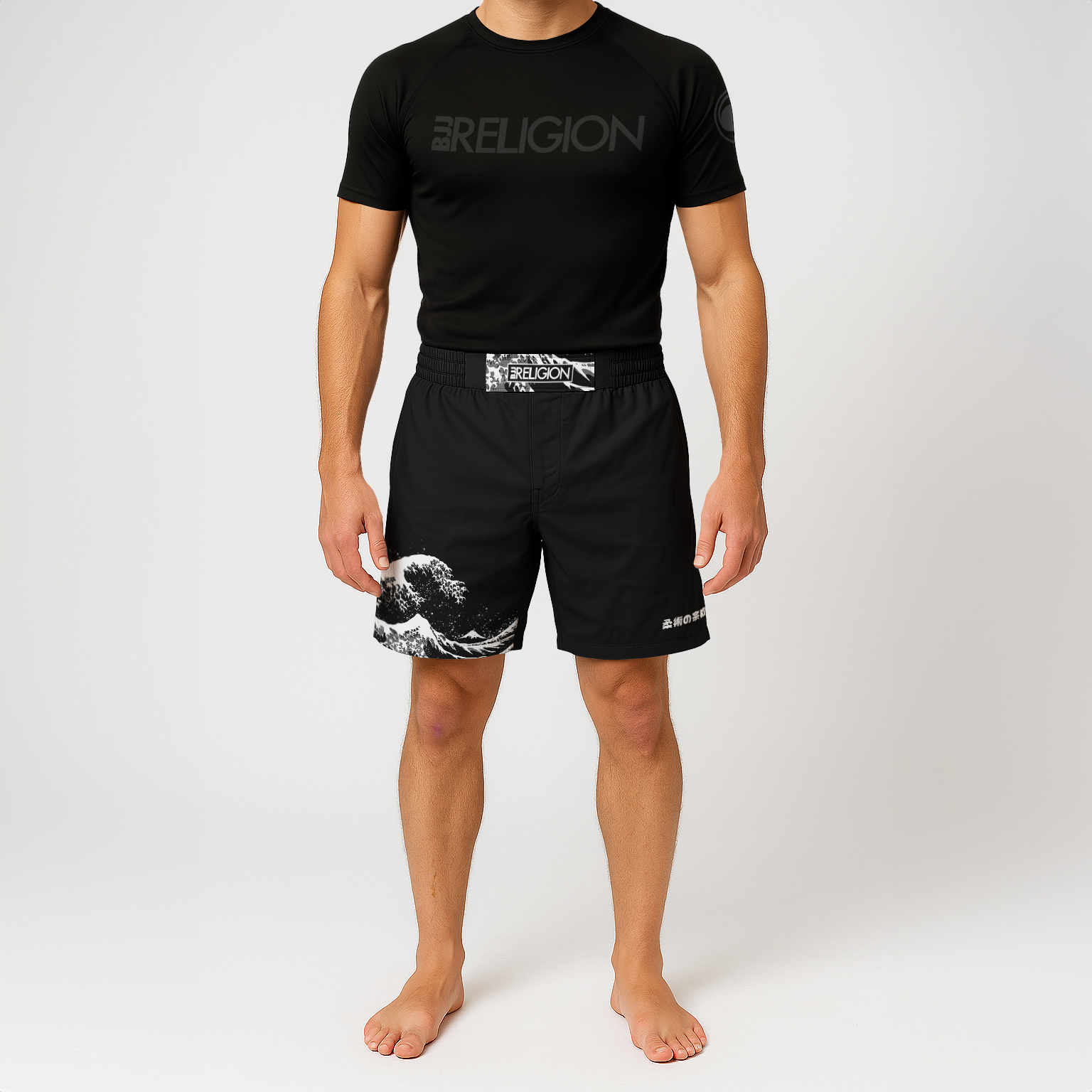
Print quality is worth considering, too. A bold graphic is not a problem, but cheap surface printing can crack or peel after repeated washing. If you are cost-conscious, a clean solid color or simple design often gives you more flexibility across classes and tournaments.
Consider Academy Culture and Competition Rules
Before buying, check what your academy expects in no gi class. Some schools have a uniform policy, require a school rash guard, or ask students to wear certain colors for team events. Others are more relaxed as long as gear is clean, functional, and appropriate for training.
For competition, rules can vary by organization and event. Some require specific color combinations or restrict certain designs, while others are more flexible. If you compete regularly, a neutral pair of grappling shorts is a practical backup. It can save you from scrambling to borrow gear on tournament morning because your favorite pair does not meet the event’s requirements.
Also consider modesty and layering. Many grapplers wear compression shorts or spats underneath their grappling shorts for comfort and coverage, especially during high-paced scrambles. That is a personal preference, but your outer shorts should still fit well without relying on an underlayer to keep everything in place.
Match Your Shorts to Your Budget and Rotation
You do not need a drawer full of shorts before your first no gi class. One reliable pair is enough to start, but two or three pairs make training week much easier. If you train Monday, Wednesday, and Saturday, having a rotation means you are not rushing laundry or re-wearing gear that has not been properly washed.
Spend for construction, fit, and comfort before spending for graphics. A less expensive pair that fits your body well and survives regular washing is a better buy than premium-looking shorts that twist at the waist every time you shoot. JiuJitsu.com carries grappling gear made for the demands of Brazilian Jiu Jitsu, so you can compare cuts and features based on how you actually train.
Wash your shorts after every session, turn them inside out when possible, and avoid leaving them sealed in your gym bag after class. Proper care will not fix poor stitching, but it will help a good pair keep its shape and fabric longer.
The best grappling shorts are not the ones that draw attention during warm-ups. They are the pair you wear through takedown rounds, guard passing, and one more round at open mat without thinking about them at all.
Shop Our New Releases
Fast & Free Shipping!