How to Grip Fight Effectively in Jiu Jitsu

A round can feel lost before either person hits the mat. You reach for a collar, your partner strips it, and suddenly they have a sleeve-and-collar connection that makes every movement feel late. Learning how to grip fight effectively changes that exchange. It gives you a better chance to dictate distance, enter your preferred positions, and keep your opponent from building theirs.
Grip fighting is not just trying to hold on harder. In Brazilian Jiu Jitsu, the best grip often lasts only long enough to create the next useful action: an angle, an off-balance, a pass, a takedown entry, or a clean guard recovery. Treat it as a conversation of position and timing, not a test of forearm strength.
Start With Position, Not Grips
A grip is only as good as the position behind it. If you are upright, square, and reaching from too far away, even a strong collar grip is easy to peel off or turn into a drag. Before reaching, put your feet in a stable stance, keep your elbows near your ribs, and use your head and shoulders to stay connected.
From standing in the gi, think about winning inside space first. Your hands should be between your opponent's hands and your torso whenever possible. That makes it harder for them to establish dominant collar ties, sleeve grips, or underhooks. Once you have inside position, your grip has structure behind it instead of being an arm extended into open space.
The same principle applies from seated guard. If you sit back and reach for sleeves with straight arms, a standing passer can easily control your legs or back away. Sit tall enough to move, keep at least one foot ready to manage distance, and connect your grips to an immediate guard entry. A sleeve grip paired with a shin-to-shin hook, for example, is much more useful than a sleeve grip with no lower-body connection.
How to Grip Fight Effectively: Have a Purpose for Every Contact
Newer students often grab the first available fabric and wait to see what happens. That is understandable, but it creates a common problem: your hands are busy while your opponent is free to build a better position.
Before you take a grip, know what it is meant to do. A cross-collar grip may help you pull posture forward for a collar drag or set up an arm drag angle. A same-side sleeve grip can limit a posting hand as you enter a tripod sweep. A pants grip near the knee can steer a leg during a toreando-style pass. In each case, the grip is connected to a job.
A useful question during drilling is: “What does this grip stop, and what does it create?” If you cannot answer either part, it may be a temporary touch rather than a grip worth fighting for.
This does not mean you need a complicated sequence in every exchange. Sometimes the right choice is simply denying a grip. If a training partner is working toward a strong cross-collar connection from closed guard, stripping that hand and resetting your posture may be the highest-percentage decision. You do not need to force your own attack while they still have control of your posture.
Win the Inside Space and Protect Your Elbows
Most productive hand fighting happens close to your body. Elbows that flare away from your ribs make easy lanes for underhooks, collar ties, arm drags, and sleeve control. Keep your hands active, but do not let them drift so far forward that your shoulders become disconnected from your base.
In no-gi, this usually means using open hands, wrist ties, biceps ties, and collar ties to fight for inside control. An inside biceps tie can prevent an opponent from locking their hands around your waist. A wrist tie can slow an arm-drag attempt long enough for you to square up. These controls are often brief, and that is fine. No-gi grip fighting rewards quick adjustments more than long holds.
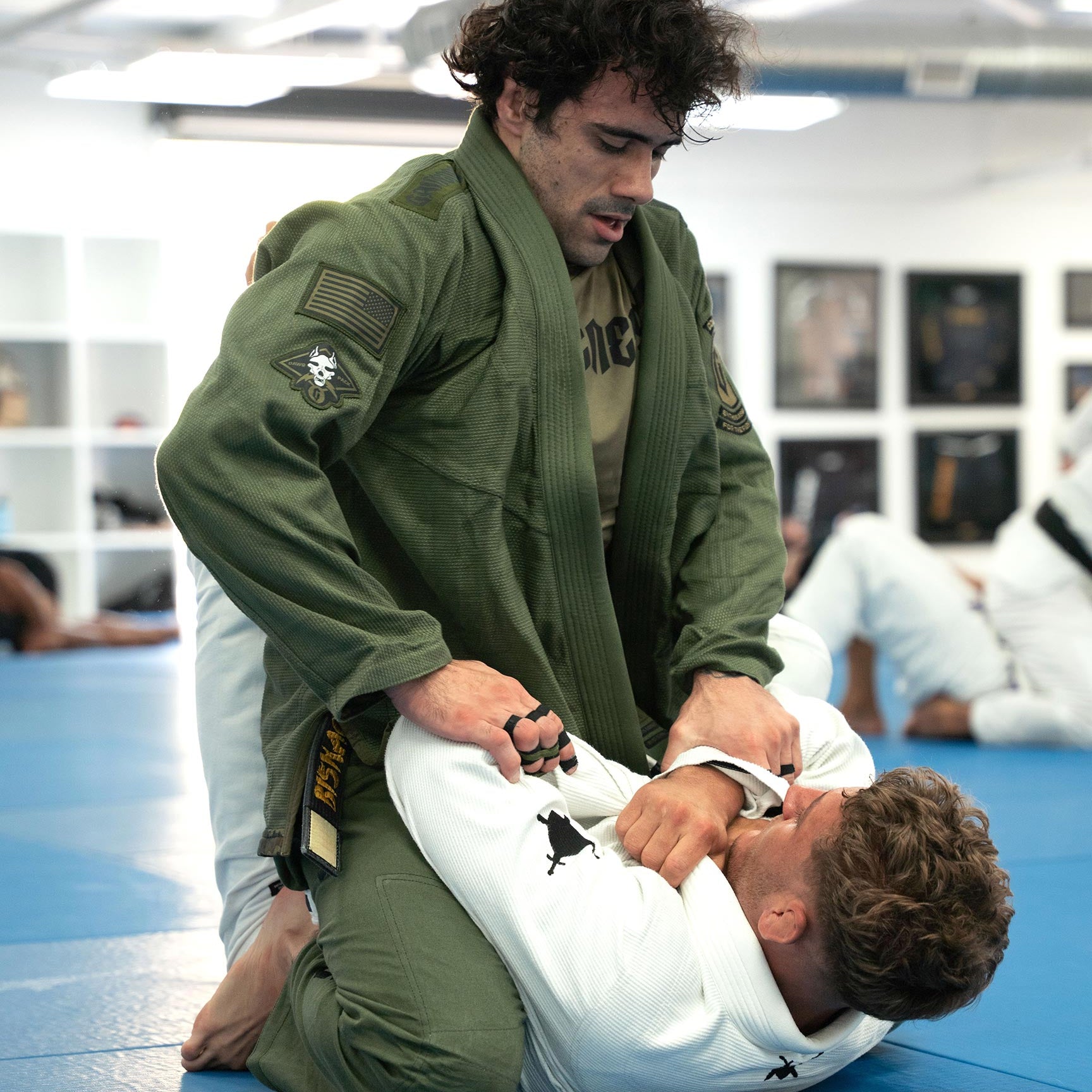
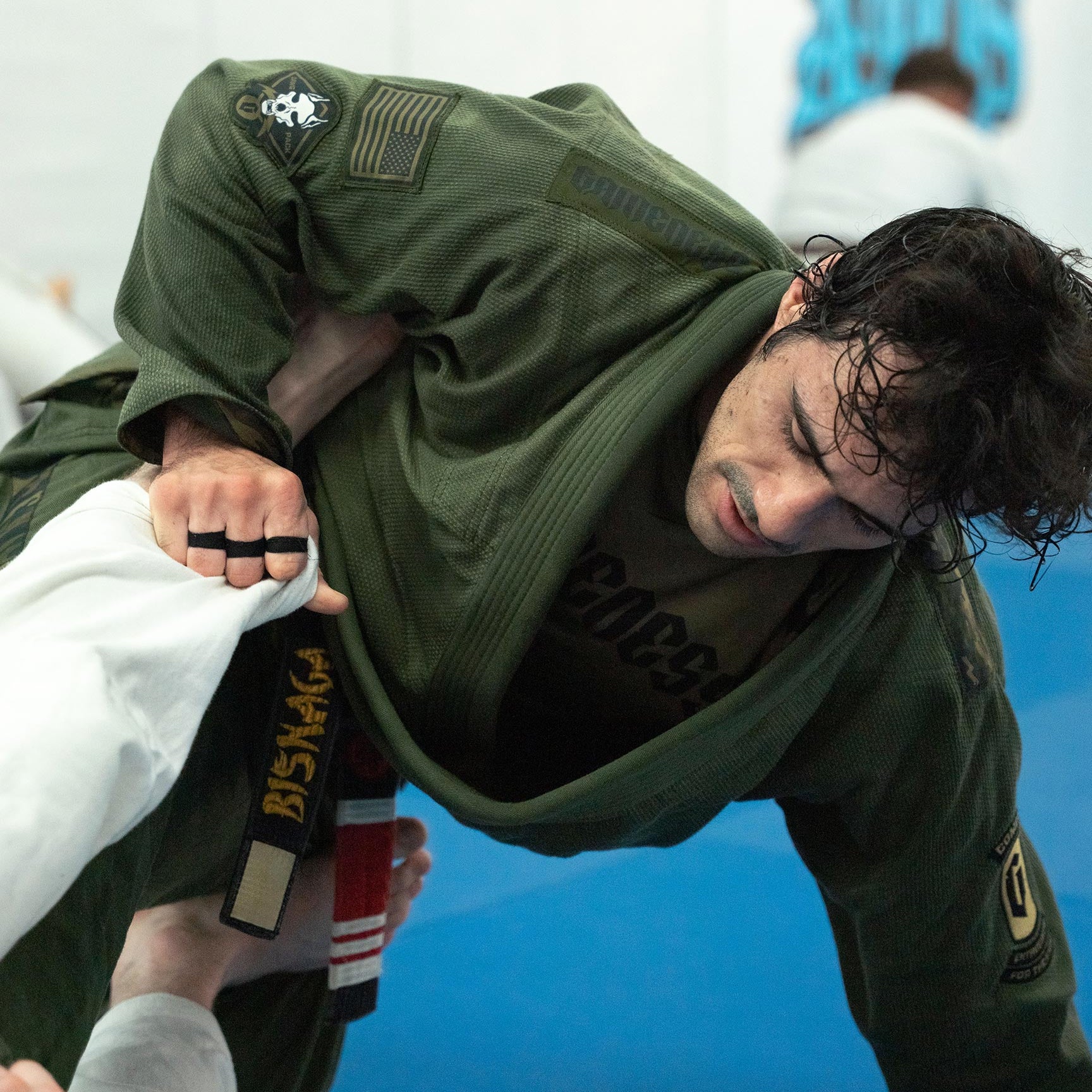
In the gi, fabric gives both people more staying power. That makes elbow position even more important. If someone has your sleeve and pulls your arm away from your body, do not just yank backward. First bring your elbow back toward your ribs, turn your grip or wrist to weaken their connection, and use your other hand to address the controlling hand. Pulling straight back with one arm often gives them exactly the tension they want.
Break Grips With Direction, Timing, and Your Whole Body
Trying to rip grips off with your arms is tiring and unreliable, especially against someone with good sleeve or collar control. Grip breaks work better when you move the opponent's hand in the direction their fingers are weakest while changing your body position.
For a sleeve grip, a common answer is to control their wrist or hand, pull your elbow back to your body, and rotate your arm as you step or circle. The exact direction depends on where they are holding and what you are trying to do next. The larger point is that your feet, posture, and angle should help your hands.
For a collar grip, address it early. If an opponent gets a deep collar grip while standing, waiting until they add a sleeve grip or start snapping your posture makes the break harder. Use your near hand to control their gripping hand, create distance with your posture and footwork, and clear the grip before they organize a follow-up.
There is also a time to accept a grip temporarily. During hard sparring, you may not be able to strip every collar grip immediately. If you cannot remove it safely, deny the second grip and prevent the position they want. A single collar grip is often manageable. Collar-and-sleeve control, or a collar grip combined with an underhook, is a different problem.
Use Push-Pull Tension to Create Reactions
Good grip fighters do not hold static grips. They use them to make an opponent react. Pulling on a collar may bring the head forward. Pushing a biceps tie may make someone post or stiffen their arm. A sleeve drag can expose an angle to the back.
In a gi stand-up exchange, a collar grip without movement is easy to defend. Add a small snap, a circle step, or a pull that makes your opponent adjust their feet, and the same grip becomes much more meaningful. You are not trying to throw them with every motion. You are looking for a reaction that gives you the next connection.
From half guard top, this shows up when you fight for an underhook. Do not simply reach under their arm and hope to win a squeezing contest. Use shoulder pressure to turn them slightly, bring your head into position, then pummel your arm inside as they respond. The underhook becomes easier because you created a reason for their elbow to move.
Build Simple Grip Sequences
The fastest way to improve is to train a few repeatable sequences instead of collecting dozens of isolated grip breaks. Pick exchanges you see frequently at your academy and practice the first two or three decisions.
For example, when passing open guard in the gi, you might practice: clear the opponent's sleeve control, establish a pants grip near the knee, then use your free hand to manage the far leg or collar. If they recover sleeve control, return to the first step rather than forcing the pass from a compromised position.
From seated guard, work a sequence such as: secure a sleeve, bring a foot to the hip or enter shin-to-shin, then either create a sweep angle or transition to a stronger guard. If they strip the sleeve, recover your posture and leg position before chasing another grip.
For no-gi standing rounds, start with hand fighting to an inside tie, move to an underhook or wrist control, and learn the reset when they pummel back inside. These short sequences make live rounds less chaotic because you recognize the exchange before it turns into a scramble.
Train Grip Fighting Without Turning Every Round Into a Dead Grip Contest
Grip fighting can become overly defensive when the goal is simply not to let go. That habit burns your forearms and can stall your development. Strong grips matter, but hand fighting should lead somewhere.
During positional sparring, give each person a clear job. Start standing with one player trying to establish collar-and-sleeve control while the other strips and enters an underhook or a takedown threat. Start in seated guard with the passer trying to control both pant legs and the guard player trying to establish a sleeve connection and meaningful lower-body hook. Short rounds of 30 to 60 seconds are enough to expose lazy reaches and poor elbow position.
You can also use regular rolling rounds with one narrow focus. For a week, decide that you will not accept a deep cross-collar grip without immediately addressing it. Another week, focus on reconnecting your elbows to your body every time someone controls a sleeve. These are small training goals, but they carry over to guard passing, takedowns, and escapes.
Competition adds another layer. A grip that is useful in a relaxed academy round may be too expensive if it takes 20 seconds to establish and leaves you standing square. Know your ruleset, manage the pace, and favor grips that lead directly to a scoring threat or a safer position. The right grip fight depends on whether you are working takedowns, defending guard pulls, passing a strong open guard, or trying to slow down a fast scrambler.
The next time a round starts, resist the urge to grab first and think later. Win inside space, connect your grips to a purpose, and make every hand exchange lead toward a position you actually want.
Shop Our New Releases

Fast & Free Shipping!


Fast & Free Shipping!
Fast & Free Shipping!

Fast & Free Shipping!
Fast & Free Shipping!

Fast & Free Shipping!