Closed Guard Versus Half Guard: Which Fits You?
A newer student often reaches a fork in the road after the first few months of sparring: should you keep trying to close your guard, or start building everything around half guard? The answer to closed guard versus half guard is not that one position is better. They solve different problems, demand different habits, and give you different ways to control an opponent.
Closed guard is one of Brazilian Jiu Jitsu's defining positions. It can slow a frantic roll, keep a larger training partner close, and create direct submission and sweep threats. Half guard is more open and more transitional. It is often easier to reach under pressure, especially when someone has started passing, and it gives you routes to wrestle up, sweep, or recover full guard.
For most students, the best move is not choosing one forever. It is understanding what each guard asks of you, then building a reliable connection between them.
Closed Guard Versus Half Guard: The Core Difference
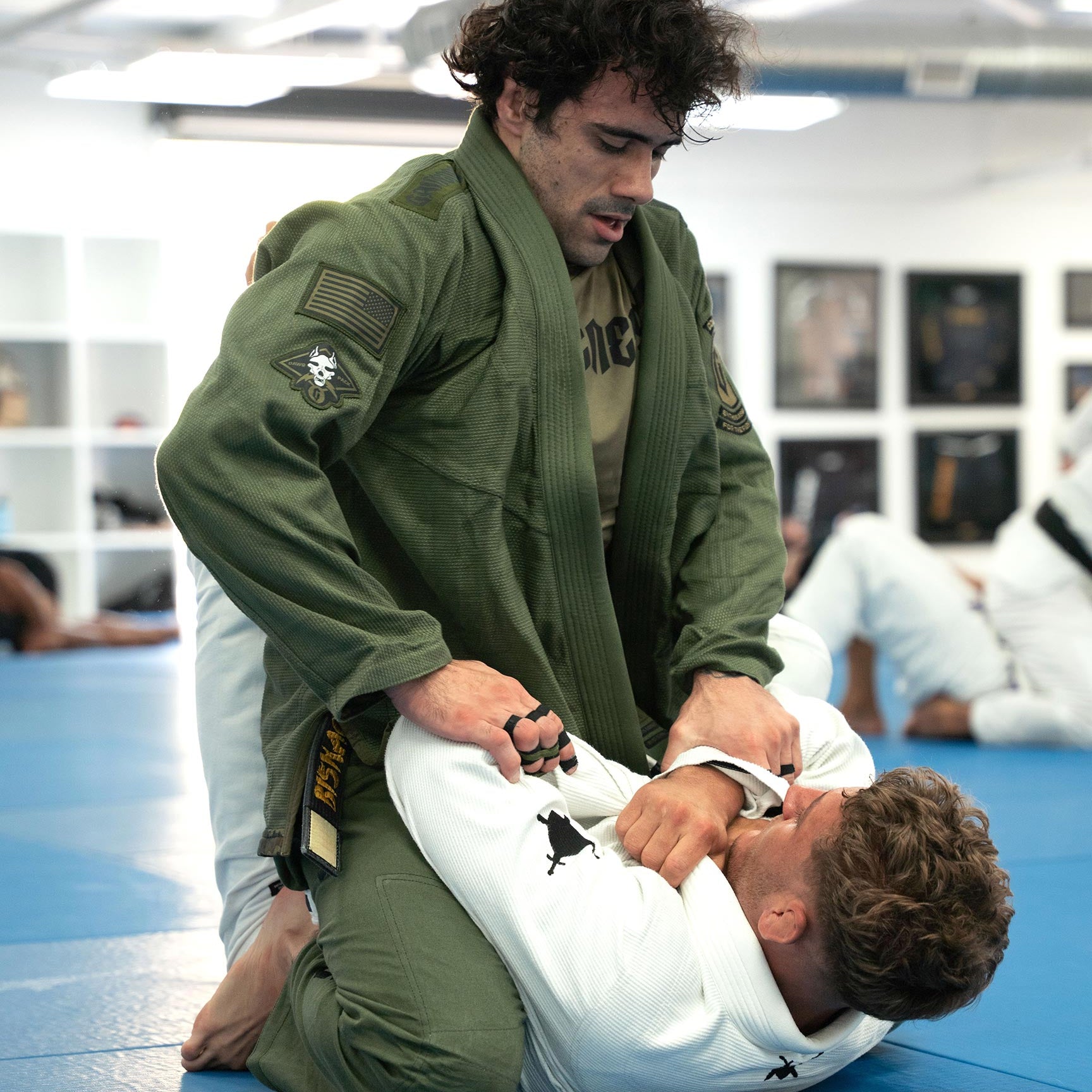
Closed guard means your legs are wrapped around your opponent's waist with your ankles crossed behind them. Your opponent is between your legs, but their hips are contained. That connection gives you a strong chance to break posture, control their arms, and force them to carry your weight while you set up attacks.
Half guard means you control one of their legs with your legs while their other knee or foot is free. There are many versions: knee shield half guard, underhook half guard, deep half guard, lock-down variations, and more. The position is less restrictive around the opponent's hips, so it requires more attention to angles, frames, and underhooks.
Think of closed guard as a position that brings the opponent into your world. Half guard is a position where you manage pressure while creating an angle to come underneath, come up, or get away.
Neither one is automatically safer. A tight closed guard with broken posture can feel extremely secure. A loose closed guard against someone standing to open it can become hard work quickly. Likewise, half guard can be a dependable recovery position when you have a knee shield and inside frames, but it becomes miserable when you are flat on your back with your head crossfaced and your far-side underhook missing.
When Closed Guard Makes Sense
Closed guard is especially useful when you can keep your opponent's posture from becoming tall and comfortable. This is why white belts are taught posture control early: if your partner can sit upright, plant their hands, and start standing, your guard is no longer doing much for you.
A practical closed guard sequence might start with collar-and-sleeve control in the gi. You pull their posture forward, cut an angle with your hips, and threaten an armbar. If they pull the arm back, their elbow may open enough for a triangle setup. If they defend both attacks by leaning hard in, a hip-bump sweep or kimura threat can become available. The individual techniques matter, but the real lesson is that closed guard works best when each reaction feeds the next attack.
No-gi closed guard has the same principle, although grips change. Head control, wrist control, overhooks, and controlling an elbow line matter more than hoping your legs alone will hold someone in place. A strong, sweaty training partner can make a passive closed guard feel surprisingly weak. Active posture control changes the position.
Closed guard is also a good place to settle a fast roll. Maybe a bigger teammate is moving quickly through open guard exchanges, or you are tired late in class and need to stop the scramble. Closing your guard, controlling their upper body, and taking a breath can help you reset without conceding position.
The trade-off is mobility. Your legs are committed around the waist, which can make it harder to create distance or chase a fast-moving opponent. Closed guard also asks a lot from your hips and adductors over time. That does not mean you should avoid it, but it does mean squeezing with all your strength for five minutes is rarely a sustainable plan.
Closed Guard Problems to Watch For
The common mistake is treating crossed ankles as control. They are not. If your opponent has upright posture, elbows inside, and their hands working toward your hips, you are defending their guard break rather than attacking.
Another issue appears in competition when an opponent stands and begins opening the guard. Holding on after the guard has been structurally opened can put you behind the exchange. A smart closed guard player knows when to attack the standing posture and when to transition to a sleeve-and-ankle open guard, a tripod sweep, or half guard as the opponent steps in.
When Half Guard Makes Sense
Half guard is where many practical Jiu Jitsu games start to come together. You may not choose it at the beginning of a round, but you will often find it when an opponent beats your open guard and starts to pass. Learning to recover half guard instead of accepting side control is one of the most useful defensive skills a developing student can build.
The knee shield version is a great example. Your bottom leg controls or hooks their trapped leg, your top knee creates a shield across their torso, and your frames keep their upper body away. From there, you can look for an underhook, create space to recover full guard, enter a wrestle-up, or off-balance them into a sweep.
Against a standing or mobile passer, half guard can be easier to reach than closed guard. If they clear one of your legs during an open guard exchange, catching their near leg and building a knee shield may be the difference between a controlled recovery and getting flattened in side control.
Underhook half guard is another important branch. When you get on your side, connect an underhook, and get your head into a good position, you can start coming up to a single-leg style finish or drive into a sweep. This is particularly useful in no-gi rounds, where getting underneath someone and connecting to their hips can be more reliable than trying to hold static grips.
Half guard has real pressure problems, though. If your shoulders are flat, their crossface turns your head away, and they have an underhook, you are usually late. Newer students sometimes call this “playing half guard” when they are really just being pinned with one leg trapped. Good half guard is built from side position, frames, and a clear plan for the near-side battle.
Half Guard Problems to Watch For
Do not stay in half guard merely because it feels familiar. If the passer has won the head position and is crushing your frames, prioritize recovery. Turn toward them, fight for inside space, make a knee shield, or use the space they create to bring your legs back in.
Also avoid chasing deep half entries without understanding the risks. Deep half can be effective, but poor head placement and loose leg control can leave you exposed to back steps, leg attacks under the rule set, or heavy pressure. Drill the entry and exit with a trusted partner before relying on it during hard sparring.
How to Choose the Guard for Your Game
Your body type, academy style, ruleset, and preferred attacks all matter. A flexible lighter grappler may enjoy closed guard's submission chains and angle changes. A stockier student with a strong wrestle-up may find underhook half guard feels natural. But these are tendencies, not rules. Plenty of bigger grapplers have dangerous closed guards, and plenty of long-limbed students build excellent half guard games.
Look at the positions you reach during normal sparring. If you repeatedly close guard but lose it as soon as opponents stand, spend time on posture control and transitions. If you repeatedly land in half guard while defending passes, make that position intentional rather than accidental. Build one sweep, one submission or back-take route, and one recovery for each position.
For example, a white belt could drill closed guard posture breaking into a hip-bump sweep, then drill knee shield half guard into full guard recovery. An intermediate student might pair a closed guard armbar-triangle chain with an underhook half guard wrestle-up. Before a tournament, a competitor can use positional rounds: begin one round in closed guard against a standing opponent, then begin the next with bottom half guard and a crossface already in place.
This kind of training shows where your guard actually breaks. It also helps you avoid a common academy habit: collecting techniques from every guard without having dependable answers when someone applies real passing pressure.
Build the Transition Between Them
The strongest answer to closed guard versus half guard is often the transition. Closed guard can lead to half guard when an opponent starts opening your legs and steps forward. Half guard can lead back to closed guard when you create enough space to bring the second leg inside and reconnect your ankles.
Picture a gi round where your opponent stands in closed guard, works one knee into the middle, and begins separating your ankles. Instead of waiting until they fully clear your legs, you can control their sleeve or collar, turn to a side, and trap the stepping leg in half guard. Now you have a position with structure and a chance to re-guard.
In another round, you may be using knee shield half guard and your opponent backs away to free the trapped leg. If their posture comes forward as they re-engage, you can pull them into closed guard before they establish their passing grips. These transitions make your guard harder to read because the opponent never gets a clean, predictable opening.
A good drilling format is simple: start in closed guard with your partner attempting a standing break. Your goal is to either retain closed guard, transition to a controlled half guard, or move to another guard without letting them settle into a pass. Then reverse it: begin in knee shield half guard and work either to a sweep, full guard, or a safe reset. Start slowly, then add realistic resistance.
Closed guard and half guard both reward patience, but not passivity. Keep your hips involved, protect your frames, and know what reaction you are trying to draw. The guard that fits you best is usually the one you can enter reliably, attack from honestly, and leave safely when the round gets hard.
Shop Our New Releases
Fast & Free Shipping!
Fast & Free Shipping!
Fast & Free Shipping!
Fast & Free Shipping!

Fast & Free Shipping!

Fast & Free Shipping!